Introduction to Industry 4.0 and AI
In
today's rapidly evolving technological landscape, the convergence of Industry
4.0 and Artificial Intelligence (AI) has paved the way for a new era of
innovation and transformation across various sectors. This chapter will provide
a comprehensive overview of Industry 4.0, delve into the concept of AI, and
explore the intricate relationship between AI and the Fourth Industrial
Revolution.
Industry 4.0 - Transforming Industries Through Connectivity
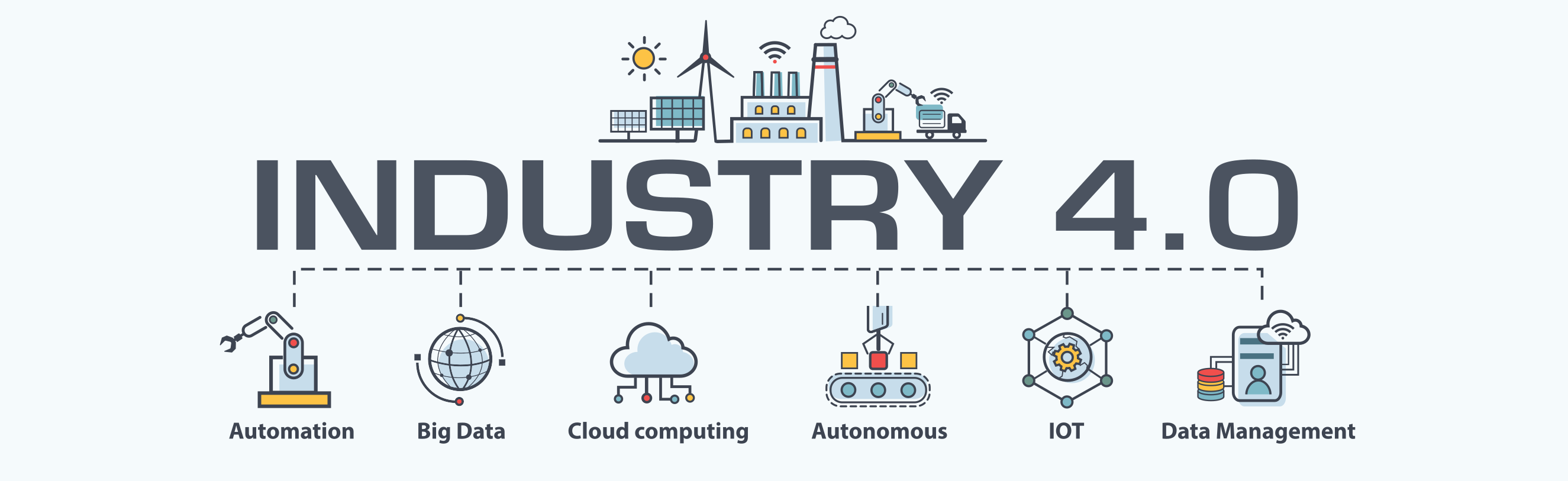
Industry 4.0, often referred to as the Fourth Industrial Revolution, marks a paradigm shift in manufacturing and beyond. It represents the fusion of digital, physical, and biological systems, resulting in a highly interconnected ecosystem. At its core, Industry 4.0 leverages advanced technologies such as IoT, automation, big data analytics, and AI to revolutionize traditional industries.

Industries are experiencing unprecedented levels of automation, efficiency, and customization. Smart factories equipped with IoT sensors enable real-time monitoring of equipment, optimizing production processes and minimizing downtime. This seamless connectivity enables predictive maintenance, reducing costs and improving overall productivity.
The Power of Artificial Intelligence in Industry 4.0
Artificial
Intelligence, often synonymous with cutting-edge technology, lies at the heart
of Industry 4.0's evolution. AI encompasses a range of techniques, including
machine learning, deep learning, natural language processing, and computer
vision. These technologies enable machines to learn from data, make informed
decisions, and perform tasks that traditionally required human intelligence.

AI's
role in Industry 4.0 is vast and transformative. Machine learning algorithms
analyze massive datasets to uncover patterns and trends, driving informed
decision-making. Smart algorithms optimize supply chains, automate quality
control processes, and enhance demand forecasting accuracy. Cognitive
capabilities, such as language understanding and problem-solving, enable AI
systems to interact with humans and collaborate in complex scenarios.
AI's Nexus with the Fourth Industrial Revolution
The
Fourth Industrial Revolution is characterized by its capacity to merge the
physical, digital, and biological worlds. At the heart of this fusion lies AI,
acting as the bridge that connects these realms. AI's ability to process,
analyze, and derive insights from vast datasets revolutionizes how industries
operate.

AI
not only fuels data-driven decision-making but also empowers autonomous
systems. Robots equipped with AI navigate complex environments, collaborating
with humans in manufacturing, logistics, and healthcare settings. AI-driven
innovations transcend boundaries, enabling predictive healthcare, personalized
marketing, and efficient energy management.
In
summary, Industry 4.0 and AI stand as two pillars of modern innovation. As
industries embrace interconnectedness and intelligent technologies, the
boundary between the physical and digital realms continues to blur. This
convergence heralds a new era of possibilities, where AI-powered insights drive
efficiency, creativity, and a reimagined future.
With
this foundation in place, the subsequent chapters of this blog will delve
deeper into the intricate AI technologies that are reshaping Industry 4.0 and
transforming how we perceive and interact with the world around us.
Comments
Post a Comment